

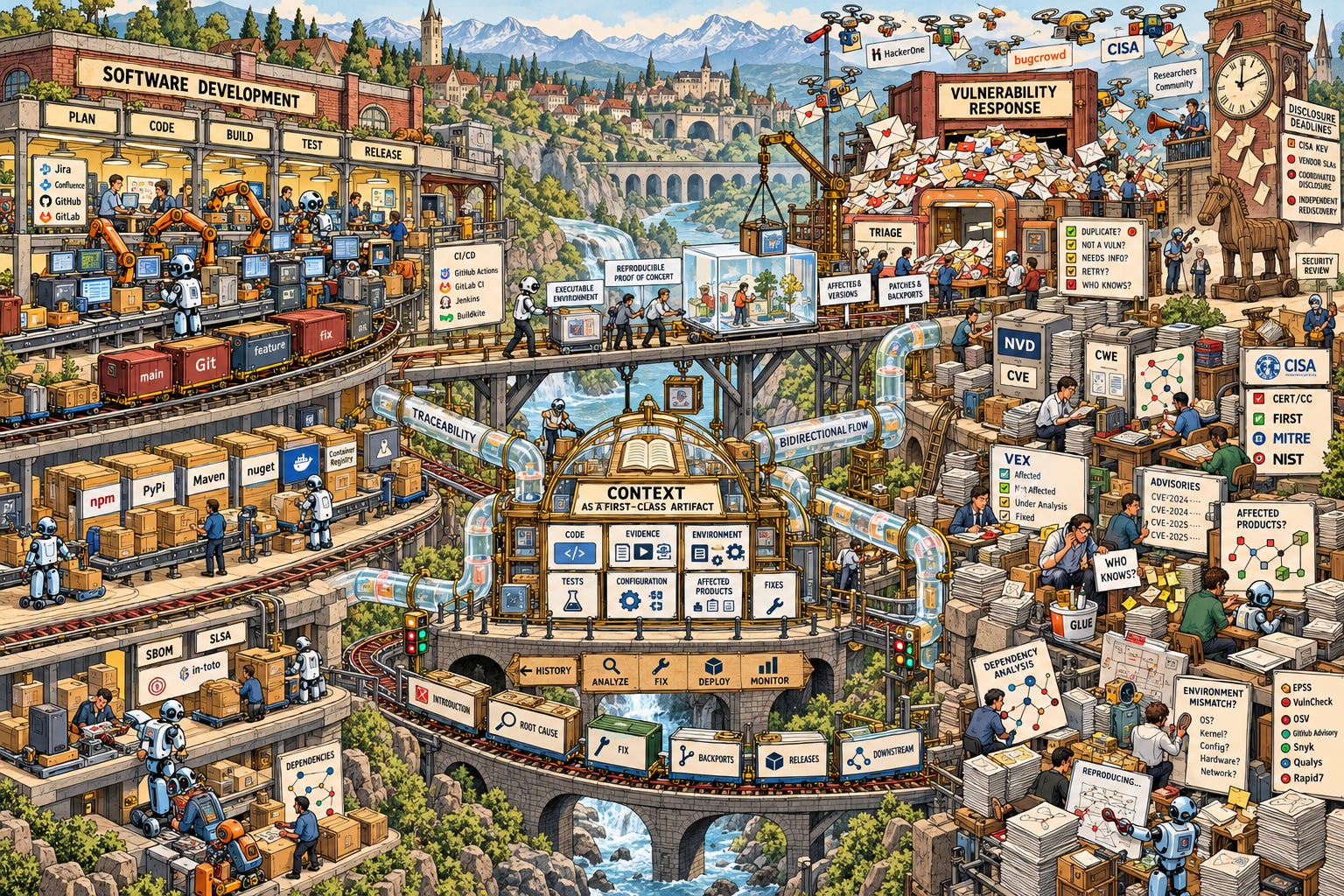
AI is scaling software development. The same must happen to vulnerability remediation. Not because of some impending vulnpocalypse, or whatever the latest marketing hype calls it. We simply can’t continue operating like this if we want to scale. We owe a change to our industry, and I think we’ll be much better off for it.
Software development got its foundations right
Software development underwent “a couple” pivotal changes. One was the adoption of agile/lean methodologies, in contrast to rigid waterfall-style approaches. With exceptions in certain domains, including mission-critical systems (for very good reasons!), agile development has stimulated the creation of tools, practices, processes, etc., to let engineers iterate fast on features, prototypes, testing and so on.
Codebases are massive objects to manage, but we have Git, workflows, CI/CD frameworks of any sort, dependency tracking and pinning (not perfect, okay…).
And all of this existed before AI!
The software industry was pretty much ready when LLMs were found to be good at writing code, because it already had the right foundational tools to manage LLM-generated code at scale.
If an agent screws up a commit, then a unit or integration test will catch it (at least, we know how to use the tools to set it up that way). We can repro the entire system, test, revert when things go wrong.
We can confidently throw “coding problems” at agents and let them work, because we can build guardrails on already-strong tooling foundations.
We’re at a point where an agent-monitored inbox understands when a user is reporting a bug or asking for a feature, dispatches it to a few agents to implement, and communicates back to the user. This really happened to me recently when I emailed support@<productname> to report a bug and ask for a feature, just to see the feature plopping in the app on my phone 12-18 hours later.
When I told a software engineer about it, they weren’t particularly surprised.
Now let’s move to the security world.
Welcome to the PSIRT inbox
Imagine a similar example with a PSIRT or OSS maintainer inbox.
On both sides, reporter or responder, there’s a few days/weeks where a bunch of humans are called in to figure out what the heck the other humans (or agents) sent.
Not everywhere.
I recently spoke with three people working across vulnerability response and management, including vendors of vulnerability-management solutions and PSIRT practitioners at smaller and larger organizations.
My sample is tiny and certainly not representative. Still, the contrast was interesting.
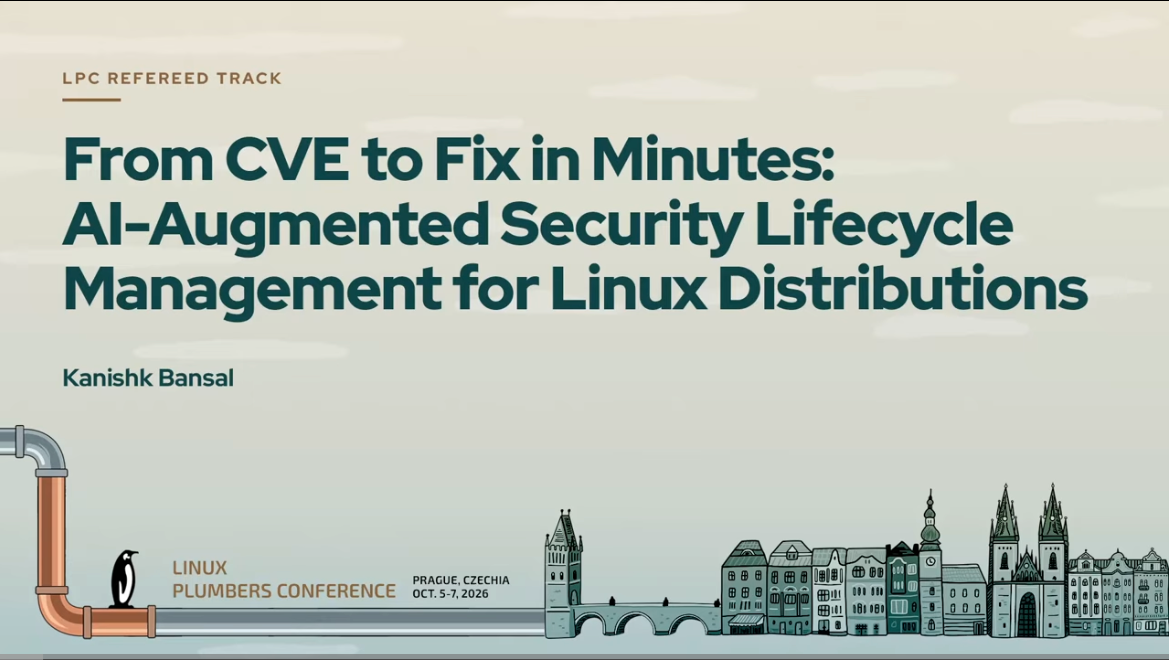
I wasn’t surprised to hear that some enterprises have already invested in custom automated solutions where LLMs ingest vulnerability reports, triage and deduplicate them, involve humans when necessary, dispatch work to engineering teams, and track remediation. Here’s a very recent example from LPC 2026:
Nor was I surprised to hear that, in smaller organizations and among maintainers, the process often begins with a human staring at an inbox and asking themselves:
Is this PoV/PoC real?
There are many variations of that question:
Is the vuln bad?
Is it reachable?
Does it have a repro?
Does the repro run anywhere or does it have lots of assumptions?
Does it come with a proposed patch?
Has the patch been tested?
Is this a duplicate or small variant of what’s been already reported?
Under what threat model assumptions is this a security issue or just an annoyance?
For what downstream consumers does this matter (at all)?
Is this a vulnerability in the first place?
Humans will scale in this phase, because we have tools that help answer parts of these questions faster than before. Dirt-cheap generic classifier (Jev style), static analysis, code search, vulnerability databases, dependency scanners, advisory feeds, and many others.
These tools, however, are compartmentalized.
There’s no git blame equivalent for vuln records/reports/context.
We’ve always needed better tools to answer those questions, but so far we’ve managed to just push through with bespoke solutions, spreadsheets, runnable Dockerfiles as a reproducible PoC, institutional knowledge, and people who know which other people to call.
In my work, if it doesn’t ship with a runnable container image that stands on its own, it’s not a finding. I know many do the same, but I don’t see/know any best practices or de-facto standards around this. Sure, PoC||GTFO all the way, but…that’s not enough. Every PoC is different and 2 PoCs for the same vuln may not be strictly comparable, let alone to be proven computationally equivalent. They don’t have “an interface” or “a contract.”
LLMs are making the limitations of this arrangement harder to ignore.
I want to look at the opportunities this gives us
Linux maintainer Greg Kroah-Hartman in his recent talk at Kernel Recipes 2026, “Security in the LLM age” gives an essential counterweight to those screaming “vulnpocalypse.” Thanks, Luca, old-time friend and founder of Doyensec, for pointing me to that talk.
I agree with this skepticism, but I don’t like the conclusions.
True, maintainers should push back on poor quality vuln reports. AI is just making this issue more evident by increasing the volume of noise. Humans, too, have been writing poor quality reports; if anything, unlike humans, agents can be instructed to follow a structure consistently, assuming we provide the right requirements and enforce them.
However, we should not stop at saying “it’s all right, we’ve seen this before,” because we’d be just missing a great opportunity to stimulate innovation in this space.
Think about the traditional process. A vulnerability gets reported. Responders validate it, coordinate under embargo, involve multiple vendors, attend meetings, maintain spreadsheets (!!!), prepare patches, negotiate disclosure dates, and eventually release advisories and fixes. We’re looking at 90-120 days, half a year, sometimes “monster timelines” close to a year!
Everyone pinky-swears not to break the embargo, and the patch and CVE will be ready when it will be ready.
This isn’t all bureaucracy, of course. Maintainers and responders have multiple layers of very difficult work: they map the upstream evidence to their own branches, backports, build options, products, and deployments. It takes time.
But there’s a more fundamental problem: private coordination can no longer assume exclusive knowledge of a vulnerability, because the economics of rediscovery has changed.
The clock ticks faster now.
Another researcher with access to the same code and similar tools may independently discover it. Because we’re at a point where the most advanced LLMs don’t even need complex tools, decompilers or disassemblers: I’ve seen frontier models rewriting part of a decompiler on the spot, using some Perl/Python scripting while a subagent was reading Ghidra source code to understand corner cases.
The possibility of independent, parallel (re)discovery existed before AI, and when clashing disclosures happens…it is a biiiig, big drama. I expect we’ll see less drama as we get used to the new economics.
Second Security’s “The Patchless Window” examines exposure and silent patching: the interval between a public code fix and publication of its CVE. They matched 18,594 OSS CVEs published from January through August 2026 to their public fixes, showing that silent patches come weeks/months ahead of the disclosure—when and if a formal disclosure comes.
I’ve done the same analysis around May and repeated it across all CVEs and OSS code bases I could fit on my SSDs. And…yep, these numbers are very real! Not that we didn’t know about this phenomenon, but a reminder was due.
The good news is that if we capture silent patches as a leading indicator, disclosure and remediation processes have extra lead time. But if the vuln affects a (downstream) critical system, a mishandled disclosure may have catastrophic consequences.
I’m not saying coordination is no longer necessary, but it’s becoming a long pole.
We should keep questioning what coordination is accomplishing, which parts genuinely require time, and which parts consume time simply because the necessary context is difficult to obtain and share.

Alex Matrosov is right in saying that AI-assisted research is undermining the assumptions behind long embargoes, particularly in firmware and hardware (where they’re ridiculously long and excruciating).
How do we make coordination substantially more effective when independent (re)discovery is becoming cheaper? I’ve written most of this draft just a few days before PHP2Shell but hey…in a couple of days we’re already beyond that with variants across the usual suspects.
The human glue doesn’t scale
It’s easy to say that product security and PSIRT teams should move toward proactive evaluation, continuous vulnerability assessment, and faster delivery of fixes.
But how?
Are we giving them the foundations they need? I don’t think so. At least, not across the industry.
I don’t think we have the right tools, globally. There are great tools that responders use (e.g.,Sourcegraph/Sourcebot, Joern, Semgrep, CodeQL, Yara, vuln feeds, scrapers), but they’re still glued together by tribal knowledge, human skills, custom ad-hoc formats, etc.
This glue has served us surprisingly well.
It has also come at a significant cost in human effort, duplicated analysis, and sometimes burnout.
And I don’t see this glue holding up at the volume and speed of future vulnerability discovery.
We have public and private vulnerability feeds, but interpreting them and connecting their information to actual code (including binary code!), affected products, and remediation decisions is largely left to individual organizations.
Let’s have LLMs figure that out, no?
Talking to PSIRT folks, they confirmed the same view of VR folks: that, without full context and access to all of the code, LLMs are not very useful at responding and remediating. This context can be built for OSS and I’m sure someone has built it. Building it for closed systems for private organizations is harder.
That precious “vuln-to-code-site context” now exists in two places, but in neither case it’s easily accessible. I’m not aware of workflows designed to design and preserve this context. We should focus here.
The kind folks that reviewed drafts of this writeup made two great points, which I’ll revise later. The TL;DR is that disclosures would proceed a bit faster, would be easier to automate, and would be cheaper if we think in terms of “security claims accompanied by structured, executable and reproducible artifacts.” Even vulnerabilities that are initially discarded (e.g., because out of scope) are worth keeping. Over time, this approach would help accumulate invaluable knowledge for humans and agents to tap into.
Today, much of that knowledge/context lives in two places.
(1) In “the glue”. People’s heads and the tools they have assembled: the humans that know the systems, who have been relentlessly researching, reporting, responding, patching vulnerabilities. They know that a certain patch fixes more than its commit message suggests. They remember why a mitigation didn’t work on a particular product. They know which downstream fork is unusual, which configuration matters, and which earlier vulnerability is surprisingly similar.
Some of that knowledge is documented. Much of it isn’t, or is scattered across tickets, mailing lists, code reviews, advisories, and private conversations. Sure enough the public part of it has been ingested while training frontier cyber LLMs.
(2) In the opaque belly of the LLMs that have ingested code bases and vulnerability feeds.
Models trained on code and security material can often connect vulnerability descriptions to bug classes, CWEs, coding patterns, and fixes. With access to repositories, feeds, and external tools, agents can reconstruct even more context.
You can ask (1) a human-with-tools or an (2) AI agent to contextualize a vulnerability or a patch with the affected code, abstract it to the bug class or CWE, and they will do it.
But that doesn’t mean the evidence is explicitly stored, current, traceable, or readily reusable.
Humans can explain very well. Humans with good CLIs and datasets can answer quite fast, but their time is finite and we’re far from fast. LLMs are relentless, have virtually infinite storage but they’re somewhat expensive to query as a service or host, they need to generate tokens to be able to explain, and their answer isn’t always the same. Jev-based decision systems are very cheap, but those can’t reason nor explain. They may be a useful tool to “connect the dots.”
Even the latest greatest frontier cyber models will burn lots of tokens on such tasks and time if you don’t keep an eye on them. And LLM expansion is still bound to physical and geopolitical constraints.
In both cases, reconstructing that context has a cost and an uncertain future.
Do we need the Git of vulnerability management?
Git didn’t make software development scalable simply by “storing code.” Surely it’s facing its own challenges, but we’re catching up already (thanks, Connor, for mentioning Scion here).
Git gave us a common way to represent, preserve, inspect, compare, and exchange changes. An ecosystem of tools and workflows grew around those capabilities.
What is the equivalent for vulnerability research and response?
We have CVEs, CWEs, advisories, VEX documents, wishful SBOMs (not attestable), commit histories, issue trackers, patch metadata, and various vulnerability exchange formats.
These are useful building blocks, but they don’t automatically give us a coherent, inspectable history of a vulnerability and its relationship to code and affected systems.
Do we need better tools to preserve that relationship?
Imagine if we were able, at a scale and for “every” system, to trace a vulnerability backward through commits to understand when and how it was introduced, and forward through patches, backports, releases, product variants, downstream dependencies, across products. There is no universal software library, but each organization can get close to creating such a library for their business.
Imagine a vuln report including the evidence that another human or agent could inspect and reuse: the reproducer, its environmental assumptions, the relevant code locations, the threat model, the affected configurations, the proposed fix, and the tests supporting it.
I think this information should be evolving alongside the code, rather than becoming an unstructured publication artifact the moment a vulnerability record is released.
Without depending on an LLM for reconstructing the context, a security team could revisit earlier conclusions when a configuration, dependency, or threat-model assumption changes.
Pieces of these capabilities already exist in different tools, research projects, and internal systems.
But we don’t yet have a broadly usable way to preserve and connect the evidence needed to reason about vulnerabilities, fixes, and affected systems together.
I’m not saying we need better vuln feeds or dashboards. But I don’t think the answer is to wrap an LLM tasked to reconstruct context that, by the way, is already there! It’s just fragmented/scattered.
I think vulnerability research and response need a scalable way to manage reproducible context.
If you know of such systems, please tell me.
Systems where humans and agents can contribute findings, inspect structured evidence, reuse previous analysis, and update “claims as code” and environments.
The analogy with Git is infantile, of course. Vulnerability context is messier than source control. It’s uncertain, has incomplete evidence, changing threat models, private information, conflicting assessments, and downstream systems that may not even expose their source code.
But maybe those are exactly the reasons we need stronger foundations.
Reproducible context before automation
I wrote this piece to help me find some clarity in a very foggy thought. I haven’t figured out architecture, formats, or even all the use cases. I don’t even know if any of this is really needed: maybe the models will be so cheap and available that it’ll all be a snap. Or maybe not.
And I’m not suggesting that one universal platform should solve everything.
But I increasingly think that a fundamental step toward making good use of LLMs in vulnerability remediation is to first build better ways of managing the context they need.
Otherwise, we risk spending enormous amounts of compute automating the reconstruction of knowledge that should have been preserved and shared in the first place.
Software development had decades to build the infrastructure that today’s coding agents benefit from.
Vulnerability response has its own tools, standards, and practices, but too much of the context connecting them still lives in human glue and tribal knowledge.
AI is scaling vulnerability discovery. If we want remediation to scale with it, we need to scale the context that makes remediation possible. This is somewhat feasible for OSS, but I see a loong way to get there for closed/private software. Let alone for binary/object code.
Deep thanks to all feedback providers.
Ange Albertini, Connor Davis, Noah Spahn, Jonathan Reiter, Ryan Nolette, Yuval Ostrovsky, and a dozen of anonymous.
If you gave me feedback on this article and you wish your name to appear here, just let me know.